Facebook    Instagram www.ChildCareCareers.com (877) 222-6070
ChildCare Careers

School Newsletter

September 2026

Inspirations, Insights, and Staffing Solutions
Header Image

Upcoming Events

Conferences & Industry Opportunities

Oct. 2-3
GAEYC - Annual Conference
Alpharetta, GA
More details
Oct. 8-10
Child Care Success Summit 2026
Arlington, TX
More details
Oct. 15-17
ILAEYC - Growing Futures Conference
Springfield, IL
More details
Oct. 16-17
WAEYC - Annual Conference
Seattle, WA
More details
Oct. 16-18
FLAEYC - Annual Conference
Jacksonville, FL
More details
Oct. 18-21
PACCA - ECE Summit
State College, PA
More details
Oct. 27-29
FHSA - Annual Conference
Orlando, FL
More details
Oct. 27-29
EveryChild CA - Fall Technical Assistance
Newport Beach, CA
More details

DIRECTORS' CORNER

Building Strong Routines Starts with Consistency


Directors Corner Image

September is when classroom routines truly begin to take shape. As children settle into the school year, consistent schedules, familiar expectations, and dependable staffing help create the stability they need to feel confident and thrive.

While occasional staff absences are inevitable, maintaining classroom consistency doesn’t have to be a challenge.

This is where ChildCare Careers supports your classrooms.

Having reliable substitute teachers available helps minimize disruptions, supports smooth transitions, and ensures the focus stays on children’s learning, growth, and daily success, not on staffing gaps.

At ChildCare Careers, we’re committed to helping your program maintain momentum throughout the school year by providing dependable, qualified substitutes when you need them. Together, we can keep classrooms running smoothly so routines stay intact, teachers feel supported, and children continue learning with confidence.

Here’s to a successful September filled with consistency and smooth routines

Call us at (877) 222-6070

Educator Focus

For Preschool Classroom Design, Less is More

By Cecilia Cabrera Martirena


Article Image

Throughout my many years as a preschool teacher and pedagogical adviser supporting teachers in their practice, I have come to appreciate that less is more.

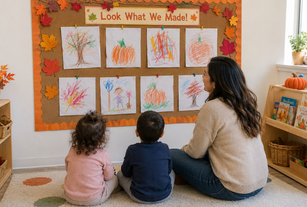
So, what does this mean? Should we avoid color and visual displays altogether? No, thoughtfully designed classrooms do not need to be empty. By carefully selecting what is displayed and giving visual elements space to breathe, we can create environments that are welcoming but also calmer and more respectful of children’s developmental needs.

Designing for children and with children
Often, classroom displays are designed entirely by adults and then presented to children. While these displays may be attractive, they sometimes miss an important opportunity: involving children in the process of creating them and deciding what should be displayed. Children should participate in the creation of classroom displays whenever possible. Depending on their age, they may contribute ideas, select images, choose work samples, dictate captions or labels, make decisions about layout and aesthetics, or even create the display themselves with the teacher’s guidance.

Making displays work for children
Meaningful displays are not necessarily elaborate ones. The most effective resources are those that children can easily understand and access (those at eye level). A visual support should serve a purpose within children’s daily experiences and help them focus their attention on what they are working on at the moment. It shouldn’t be there just to exist on the wall. The goal is to provide children with resources that help them think and that make their thinking visible.

Designing spaces that help children focus
If displays are intended to support learning, children need to be able to find and use them. When every surface competes for attention, important information can easily become lost. This is why intentionally empty spaces are not wasted spaces. Empty spaces are valuable because they create visual balance, helping meaningful resources to stand out and reducing unnecessary competition for children’s attention.

Using Color Strategically
Color is a powerful form of communication within the classroom environment, and it should be used strategically. When bright colors are used intentionally, they provide visual cues that support children’s understanding. Devote bright colors to highlighting important information, supporting organization, and defining areas. Leave other areas – walls, floors, shelves – in calmer colors, such as pastel shades.

Children need environments that offer stimulation and create opportunities for deep engagement, supporting their curiosity without overwhelming it. In my experience, the most effective environments are the ones that embrace simplicity and common sense.

*Excerpts taken from “For Preschool Classroom Design, Less is More” By Cecilia Cabrera Martirena
www.edutopia.org – Edutopia, George Lucas Learning Foundation.

Activity of the Month!

Turkey Headband

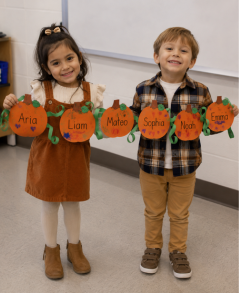
Pumpkin Vine Name Craft

Materials Needed:

  • Pumpkin-shaped orange construction paper (1 per child)
  • Green construction paper (cut into long strips for vines)
  • Crayons, markers, or colored pencils
  • Glue sticks
  • Scissors (teacher use or child-safe, as appropriate)
  • Tape or stapler for display

Have each child decorate a pumpkin and write their name in the center. Once everyone is finished, connect the pumpkins with green paper vines and display them together on a wall or bulletin board to create a festive pumpkin patch.

Closing Banner

ChildCare Careers is your trusted partner in staffing.

Need coverage or planning ahead?
Call us anytime at 877-222-6070 - we're ready to help.

© ChildCare Careers | Unsubscribe | www.ChildCareCareers.com